New: Film-based Vacuum Stent
Selfexpanding Metal Stent coated with Suprasorb ® CNP Drainagefilm
With new tools, endoscopic negative pressure therapy is continuously developing.
The latest stage of development is a innovative Drainagefilm-based Vacuum Stent:
therefore a self-expanding covered stent is equipped with the transparent open-pored thin drainage film (Suprasorb®CNP Drainagefilm, Lohmann & Rauscher International GmbH & Co. KG) for suction.
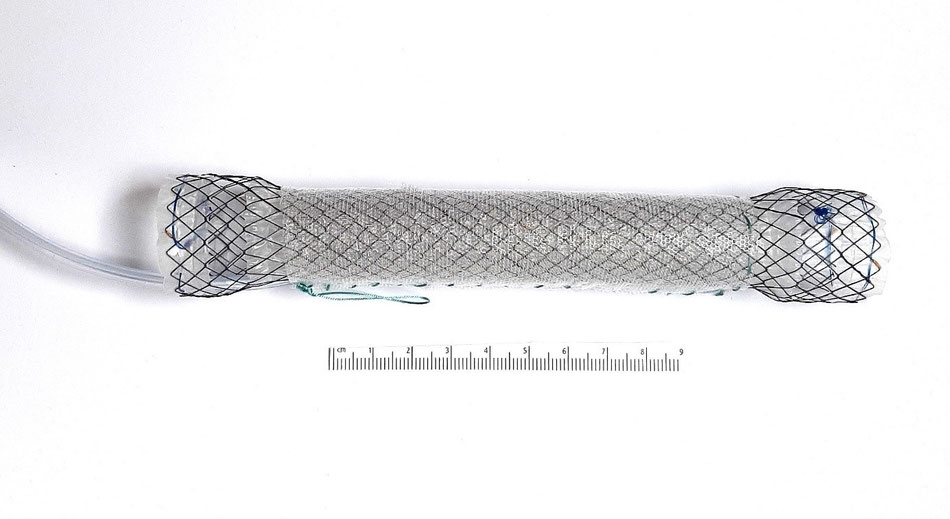
By combining existing materials, new drains can be created that can be used in ENPT and further expand the range of treatments available. A self-expanding, partially covered stent (Hanarostent Esophageal Stent; M.I. Tech, Pyeongtaek, South Korea) was equipped with the open-porous drainage film (Drainage Film Suprasorb®CNP, Lohmann & Rauscher International GmbH & Co. KG, Rengsdorf, Germany) to form a new vacuum film stent.
The combination of two specialised products (covered self-expanding stent and open-pore drainage film (Suprasorb ® CNP Drainagefilm, Lohmann & Rauscher) allows the construction of a novel vacuum stent.
The use of the thin drainage film as a drainage material has significant design advantages.
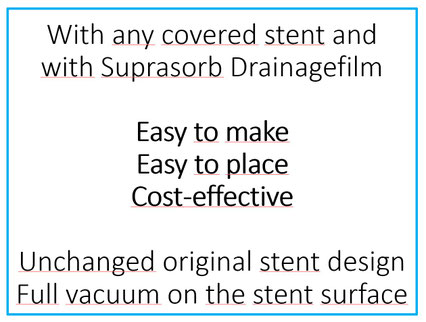
The thin film coating does not alter the original stent design.
Any (partially) covered stent can be equipped as a vacuum stent.
There is no need to use a delivery system for placement. The over-the-scope technique allows quick and easy endoscopic insertion and stent placement under direct vision.
Physical advantages include: defect sealing with secretion drainage, full surface negative pressure, less tissue adhesion than polyurethane foam due to the use of the drainage film, cost savings by using existing materials, and more.
Construction and over-the-scope technique are demonstrated in a video.
Loske G. Open-pore drainage film-based vacuum stent for intraluminal endoscopic negative pressure therapy of the esophagus. Endoscopy. 2025 Dec;57(S 01):E290-E291. doi: 10.1055/a-2569-3650. Epub 2025 Apr 3. PMID: 40179984.

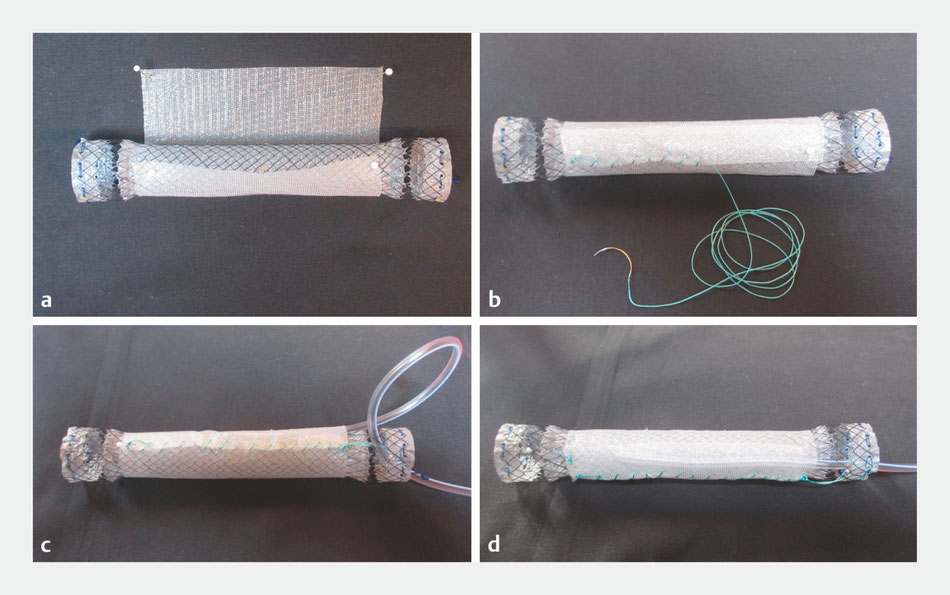
Creation of the drainage film vacuum stent. a The middle covered part of the stent is wrapped in the drainage film. b The drainage film is fixed with a suture. c The drainage tube is inserted between the drainage film and the outside of the covered part of the stent. d The newly created vacuum stent.
This new film-based vacuum stent is used to treat anastomotic leaks and perforations in the esophagus.
The new product combines a self-expanding covered stent with an open-pored transparent drainage film.
The advantages of vacuum therapy and stent technology are combined in one device.
The self-expanding stent is covered with an ultra-thin, transparent, open-pored drainage film.
No additional insertion instruments are required. The film-based vacuum stent is placed using a technically simple over-the-scope technique under continuous endoscopic visual control.
A negative pressure is applied to the drainage film using an electronic vacuum pump via a nasal tube connection. The negative pressure is distributed over the entire surface of the coated stent. The open-pored drainage film allows the stent surface to adhere completely to the esophageal epithelium and the wound defect. The wound defect is covered and additionally sealed by the negative pressure. At the same time, secretions and edema are continuously drained.
The adhesion of the drainage film to tissue differs from that of polyurethane foam. It adheres less strongly. The reason for this is the different surface structure of the materials. In polyurethane foam, the pores merge into one another. In the drainage film, the pores are spaced at regular intervals. When suctioned onto tissue, the drainage film is less vulnerable and can therefore also be used directly on the peritoneum when used in the abdomen. Polyurethane foam is not allowed be placed on vulnerable tissue. These different surface properties can be used for therapeutic purposes.
Due to its lower adhesion to the esophageal epithelium, a stent covered with drainage film is easy to remove.
A vacuum film stent may be able to remain in place longer than a vacuum stent equipped with polyurethane foam, allowing for longer treatment intervals.
The use of drainage film to cover the stent offers numerous advantages:
The original stent design remains unchanged thanks to the thin film coating.
The stent can unfold completely.
The inner lumen of the stent remains wide open.
Stents can be manufactured in any length.
Any stent design can be used.
The negative pressure unfolds over the entire surface.
There is full-surface epithelial adhesion with lower adhesion pressure.
The film vacuum stent is easy to remove.
Material tear-off of the drainage film from the stent is highly unlikely.
The tube connection and suction on the epithelium protect against migration and dislocation.
The transparency of the drainage film offers further advantages.

Video demonstrates: Construction of the stent and a new over-the-scope placement technique
https://mr316.video-stream-hosting.de/tvg/opn/cs/25/3/25693828-093be1dc_360p.mp4
Loske G. Open-pore drainage film-based vacuum stent for intraluminal endoscopic negative pressure therapy of the esophagus. Endoscopy. 2025 Dec;57(S 01):E290-E291